Merry Christmas. Enjoy this walk in Lima during the holidays.
Friday, December 24, 2010


Thursday, November 25, 2010
No Turkey but Thankful
Today is Thanksgiving. It is my first Thanksgiving outside of the United States. Normally I cook the turkey, having seasoned it the night before with salt, pepper, old bay, and injecting mojo (a mixture of garlic, lime, orange, onion, and other flavors). Thanksgiving mornings for me have been preparing stuffing, sausage and apples with sage bread crumbs. Then comes the preheating of the oven, stuffing the bird, covering it with bacon for basting and getting the gobbler in the oven. All of this is done by 7:30 in the morning.
 The process continues, throughout the morning, by making apple and pumpkin pies. Corn is shucked. A salad is made.Sweet potatoes are cut and wrapped in tin foil. Then I bake them in the oven to a soft sweet side dish steaming with aroma as I add butter and cinnamon.Green bean casserole is prepared. Rolls are baked. White potatoes boiled and then mashed. As the cooking ends gravy is made and the cranberry sauce, canned, is plated. All this is done with the Macy's Thanksgiving day parade on the television, waiting in anticipation of Santa Claus to appear followed by NFL football previews and the games of the day.
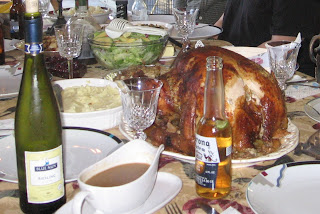 Thanksgiving dinner is really a supper: served at 2:00 in the afternoon in my house. As a family we never get "dressed." It is a casual event, jeans and T's. As the table is set the children are seen picking and tasting what is about to be served. Just before we eat each one of us says what we are thankful for. Then we dive in to the food, passing plates, and gorge ourselves.
This Thanksgiving I am in Peru. No Turkey. No cooking. No Macy's Thanksgiving day parade. No football on the television. No sweet smell of home cooking as the meal is prepared. No beer nor wine. No closed stores. No empty streets. Yes thankful.
I am thankful for my family's support. My mother, brothers, children, granddaughter, and friends, in the US. All have been supportive of the change I made moving to South America. Many of which have made it possible for me to embark on this adventure as an expatriate.They have at this time given more than I have been able to give back.
I am thankful for my new family here that has adopted me and made me feel welcome. My bride-to-be, her daughter, mother, brothers, cousins, nieces, and nephews have made me feel like a member of the family. I am thankful for the friends here that have accepted me: Peruvians ands expatriates.
Thanksgiving as a holiday is not about the turkey and the pies, the sweet or mashed potatoes, or the cranberries and the gravy. It is about a sense of awe and appreciation for all that we have and what we have shared together.
Today I am thankful and I share my thanks with you. Happy Thanksgiving wherever you may be today. Happy Thanksgiving.


This Thanksgiving I am in Peru. No Turkey. No cooking. No Macy's Thanksgiving day parade. No football on the television. No sweet smell of home cooking as the meal is prepared. No beer nor wine. No closed stores. No empty streets. Yes thankful.
I am thankful for my family's support. My mother, brothers, children, granddaughter, and friends, in the US. All have been supportive of the change I made moving to South America. Many of which have made it possible for me to embark on this adventure as an expatriate.They have at this time given more than I have been able to give back.
I am thankful for my new family here that has adopted me and made me feel welcome. My bride-to-be, her daughter, mother, brothers, cousins, nieces, and nephews have made me feel like a member of the family. I am thankful for the friends here that have accepted me: Peruvians ands expatriates.
Thanksgiving as a holiday is not about the turkey and the pies, the sweet or mashed potatoes, or the cranberries and the gravy. It is about a sense of awe and appreciation for all that we have and what we have shared together.
Today I am thankful and I share my thanks with you. Happy Thanksgiving wherever you may be today. Happy Thanksgiving.
Wednesday, November 24, 2010
Tuesday, November 23, 2010
Business is Business no matter what side of the equator
I have been spending much of my time working on developing a network of private sector professionals in Peru. Considering it is my intent to stay in Peru with my bride-to-be for the next 50 years (I told her that I would give her a 50 year commitment so when I am 99 she is on her own), I needed to start getting "connected" in Peru for business opportunities. I felt that my experience in the United States of networking and referrals was a sound business plan. As such I have begun focusing on replicating that process here in Lima.
Many have told me that in Lima it is "who you know" and not "what you know." My experience in the US was similar in that it was a combination of "who you know" and "knowing something." I am finding that to be the same here as well. It just requires a longer focus on the "who" to demonstrate the "what you know."
Some of my contacts have come over time and others very recently by just requesting them through the web. Services such as LinkedIn and Facebook are becoming important social mediums for networking in Peru. I am impressed at how quickly one can increase a contact database with minimal effort. I believe it is probably easier to establish the quality of contacts here in Peru than in the United States. This may be evidenced by the caliber and quality of contacts that have accepted me through the social networks. Developing the contacts may take longer though.
I am coming to understand that in Peru, professionals are protective of making referrals because it is considered a reflection of the one giving the referral. In the States I could ask and receive a referral on a one-call-close (first time meeting that included a sale). In Peru, referrals are more performance based: waiting to see how well you perform before sharing you with colleagues or friends. As a result, a referral here tends to lend more weight than in the North America. In North America the referral got me in the door: in Peru the referral gets me through the door.
I have found that the business relationships here become deeper too. Some of the professional relationships have become close confidences. One such relationship has been with Javier Neyra. I first contacted Javier in November of 2009 before coming to Peru. He had an ad I saw that was interesting. Over the past year we have developed a professional relationship.This is a relationship I have found to be very supportive while here in Peru.
 International Data Contact Center is one of Javier's businesses: providing English and Spanish speaking call center services that range from sales to customer service. His background includes an expertise in insurance, commercial and individual, and real estate. Javier has always been available with open ears to listen to an idea and help me evaluate it: many times letting me camp in his office when I required a place to work. Every time I have needed information, all I have had to do is ask and he has what I need immediately.
Javier has asked for me to help him from time to time. I am more than happy to assist him. Sometimes it is to review an agreement in English or get an opinion about the US market. Do not get me wrong, he is more than capable to do this with his own English skills and market knowledge. I believe he utilizes me as a resource with specific knowledge, native North American business professional, and I am happy to do so because of the relationship we have developed.
From our conversations I have learned about his family and his life. We are of similar age and experiences. We both have worked hard for our children's benefit. Our focus has been and is on success, professional and personal. In the midst of a business relationship I have found a business friend. I am finding this true with many relationships here.
As I develop my network and plant my seeds that grow to roots here in Peru my relationships here remind me of those when I was in the States. There I had developed deep relationships based on mutual respect. They became my masterminds. People like Mike Husson a sales professional and coach, Don "load the wagon" Acker, a master of team building and Chuck Heidenfelder the sales pro that would tell me why it didn't make sense and then how to make it work. Each of these over time became my trusted business friends because of a mutual respect of what we knew. The relationships I am developing here with Javier and others are the same.
I am finding, in the private sector, that the similarities are greater than the differences. Who you know is important, but so is respect for what you know. As a result the quality of life you develop gets better as you surround yourself with deeper relationships. Business is business no matter what side of the equator you are on. Develop it with mutual respect and you benefit from the relationships: both professionally and personally.
Many have told me that in Lima it is "who you know" and not "what you know." My experience in the US was similar in that it was a combination of "who you know" and "knowing something." I am finding that to be the same here as well. It just requires a longer focus on the "who" to demonstrate the "what you know."
Some of my contacts have come over time and others very recently by just requesting them through the web. Services such as LinkedIn and Facebook are becoming important social mediums for networking in Peru. I am impressed at how quickly one can increase a contact database with minimal effort. I believe it is probably easier to establish the quality of contacts here in Peru than in the United States. This may be evidenced by the caliber and quality of contacts that have accepted me through the social networks. Developing the contacts may take longer though.
I am coming to understand that in Peru, professionals are protective of making referrals because it is considered a reflection of the one giving the referral. In the States I could ask and receive a referral on a one-call-close (first time meeting that included a sale). In Peru, referrals are more performance based: waiting to see how well you perform before sharing you with colleagues or friends. As a result, a referral here tends to lend more weight than in the North America. In North America the referral got me in the door: in Peru the referral gets me through the door.
I have found that the business relationships here become deeper too. Some of the professional relationships have become close confidences. One such relationship has been with Javier Neyra. I first contacted Javier in November of 2009 before coming to Peru. He had an ad I saw that was interesting. Over the past year we have developed a professional relationship.This is a relationship I have found to be very supportive while here in Peru.
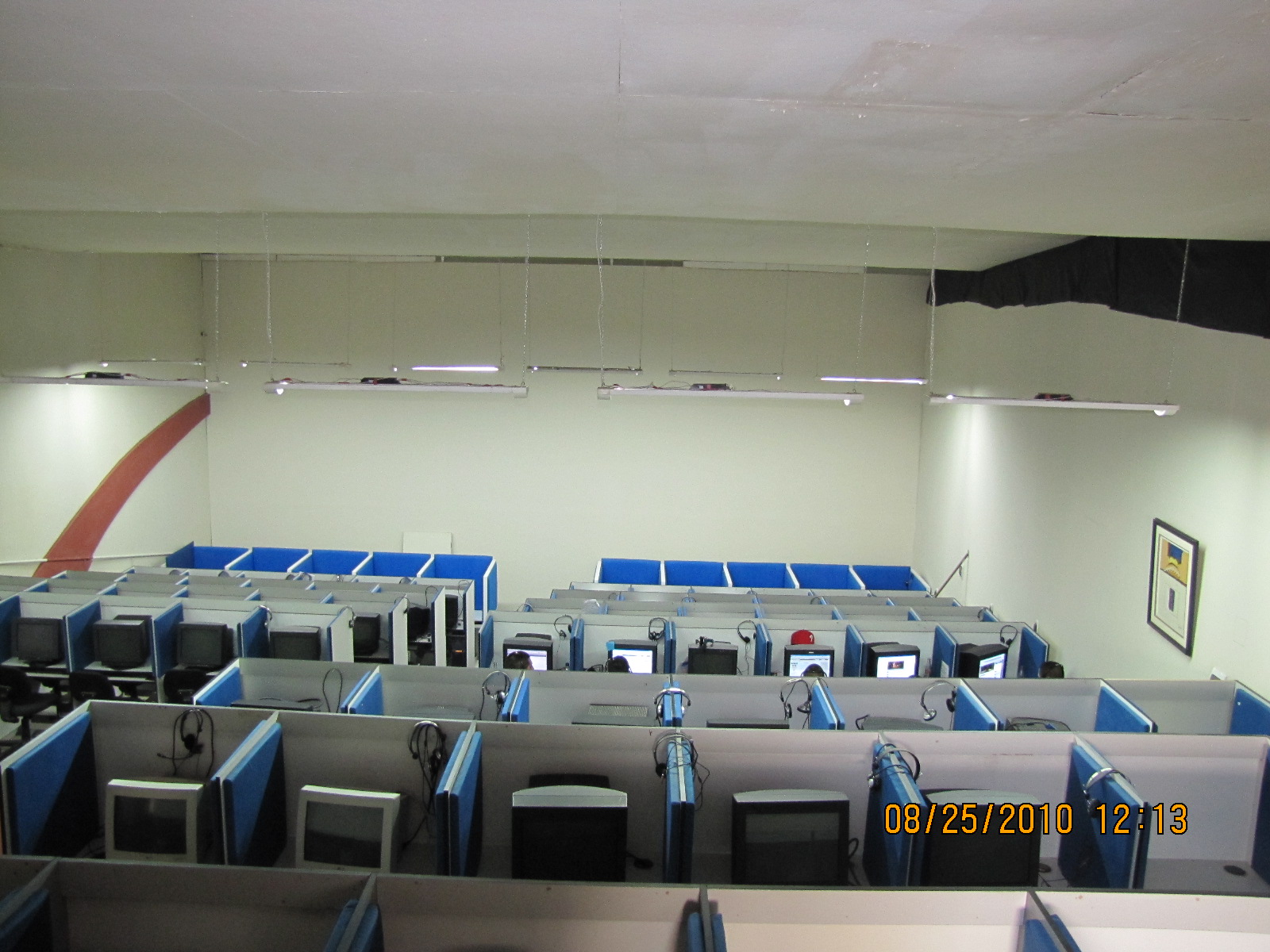
Javier has asked for me to help him from time to time. I am more than happy to assist him. Sometimes it is to review an agreement in English or get an opinion about the US market. Do not get me wrong, he is more than capable to do this with his own English skills and market knowledge. I believe he utilizes me as a resource with specific knowledge, native North American business professional, and I am happy to do so because of the relationship we have developed.
From our conversations I have learned about his family and his life. We are of similar age and experiences. We both have worked hard for our children's benefit. Our focus has been and is on success, professional and personal. In the midst of a business relationship I have found a business friend. I am finding this true with many relationships here.
As I develop my network and plant my seeds that grow to roots here in Peru my relationships here remind me of those when I was in the States. There I had developed deep relationships based on mutual respect. They became my masterminds. People like Mike Husson a sales professional and coach, Don "load the wagon" Acker, a master of team building and Chuck Heidenfelder the sales pro that would tell me why it didn't make sense and then how to make it work. Each of these over time became my trusted business friends because of a mutual respect of what we knew. The relationships I am developing here with Javier and others are the same.
I am finding, in the private sector, that the similarities are greater than the differences. Who you know is important, but so is respect for what you know. As a result the quality of life you develop gets better as you surround yourself with deeper relationships. Business is business no matter what side of the equator you are on. Develop it with mutual respect and you benefit from the relationships: both professionally and personally.
Sunday, November 14, 2010
Paying it forward between the foul lines north and south of the equator
I have two daughters that are 355 days apart in age. When they were 8 and 9 they started playing fast pitch softball. For some reason they were placed on different teams. At that time I was an executive, shirt and tie job, and would rush from the office to see their games. Game after game no umpire would show up. So I would take off my jacket, loosen my tie and in my slacks, suspenders, and wingtip shoes I began my avocation of umpiring.
 The last 15 years I have been umpiring at the NCAA Division I level. I have umpired in several conferences: including post season championships.Before returning to Peru I was asked to umpire in the women's professional league. During those years, my oldest daughter continued to participate in softball, ultimately ending her career playing four years at the Division II level: on scholarship.
Because of her involvement in softball and my umpiring we developed a second family at the Lake Lytal Lassie League in West Palm Beach, FL. Every week we were at the ball park, either at Lake Lytal or on the road playing travel ball. Lake Lytal became an extended family: celebrating the births and marriages and grieving the deaths together. The relationships we developed there were invaluable.
 Because of what softball gave to me personally I started giving back training umpires and scheduling the umpires for tournaments. My part in these tournaments was to provide young women the highest level of officials while balancing the costs to the leagues and compensating the hard work from the umpires, taking very little for myself. I trained for several years at the high school association and became a mentor to many officials that are now umpiring at different levels of the NCAA: paying it forward as my thank you to the men and women that helped me reach one of the highest levels of the sport.
 When I came to Peru I found the Federación Peruana de Softbol. I have been umpiring weekly including an international tournament last week for young women 14 years and under. For me it has been like finding my second Lake Lytal. I have been welcomed and made to feel like part of the family. The players, coaches, fellow umpires, and even the fans have, by their acceptance, helped me to understand that no matter where you are from, sports breaks down all barriers. Sports binds people together. Sports builds character and sets the example for those we care for most: our community and children.
One person I have met here in Peru that demonstrates these values is Marylu Torres. Marylu began playing softball in Lima, Peru when she was 15. The boys from her neighborhood all played baseball and their sisters where playing softball. She began playing for CAMAGÜEY at third base and batting fourth. She was a power hitter from the left side. She played for her high school in Lima's first interscholastic league.
 When Torres was16 she, and 40 other young women, tried out for the first Peruvian national team. After 2 years the team was formed and in 1978 Peru hosted its first international tournament. The teams that participated where from Argentina and two teams from the United States. Marylu remembers how much faster the US teams' pitching was and how playing them made her a better ball player.
 In 1978 Marylu enrolled in the Catholic University in Peru where she continued to play for Peru on the national team. In 1982 Marylu went to the United States to attend Queens College in New York. She played softball in the states and spent more time with Stanley. Carol even helped Marylu with English teaching her the phonetics of the language. After Marylu graduated university she began teaching English in Peru. To this day Torres still teaches. Stanley was an important person in her life. .
 Torres played third base for Peru until 1987 when a knee injury forced her to play first base for a year. In 1988 she went on to play right field. In 1991, her final year as a player, she was a designated hitter. Marylu had a batting average that was always in the high 300's to low 400's. She was such a great hitter that many at bats would result in her being hit by the pitch, intentionally to keep her from hitting for extra bases.


Because of her involvement in softball and my umpiring we developed a second family at the Lake Lytal Lassie League in West Palm Beach, FL. Every week we were at the ball park, either at Lake Lytal or on the road playing travel ball. Lake Lytal became an extended family: celebrating the births and marriages and grieving the deaths together. The relationships we developed there were invaluable.

One person I have met here in Peru that demonstrates these values is Marylu Torres. Marylu began playing softball in Lima, Peru when she was 15. The boys from her neighborhood all played baseball and their sisters where playing softball. She began playing for CAMAGÜEY at third base and batting fourth. She was a power hitter from the left side. She played for her high school in Lima's first interscholastic league.

One of the US teams, the Patriots, was coached by a Carol "Stash" Stanley. Stanley has been involved in softball her whole life as a participant, coach, inventor and mentor. She is the holder of four US Patents; STAN-MILL MITT is part of the permanent collection in the Baseball Hall of Fame in Cooperstown.Stash would return to Peru for several years with teams for tournament play. Each year she would provide a clinic for the young women of Peru. She is credited with helping establish women's softball in Peru and created the varsity softball program at SUNY Binghamton. Stanley was paying it forward to women like Marylu Torres.Torres benefited from the clinics, improving her game year in and year out.


Coaching began for Marylu in 1993 with the international team of Peru. That year the team went to Puerto Rico. She is the softball coach at the San Silvestre School in Lima working with girls from the 2nd grade to high school.

Each weekend on Sunday's you can find Marylu at the ball field: Olivares in Jesus Maria. She is a fixture in the 3rd base coaches box when the women's team Simon Bolivar Callao are playing. After each game Torres shares her knowledge, actively coaching the women of the team from the lessons of game.
During the 14 and under international tournament in Peru last week, Marylu was a coach of one of the two Peruvian teams. She is a mentor, an example of character, she binds people together. Having received so much from the game of softball Torres is paying it forward to the young women of Peru between the foul lines south of the equator.
Thursday, October 28, 2010
Who made the salad?

The other day I wanted to make a salad. After eating too much bread I decided salad was a better alternative. I went 2 blocks from my home to Calle Jose Gonzalez between Orcharan and Colon. There, six days a week, Monday through Saturday, you can find Carlos Alberto Lopez Zamora.
Carlos began selling vegetables with his father 45 years ago. His father, now 83, began selling vegetables when he was 24. At 52, Carlos is a fixture in Miraflores for his customers that depend on him daily and weekly: buying the fresh items as needed. He has operated his own stand for 26 years.
Carlos is married, over 30 years, with four children: two boys and two girls ages 28 to 15. He lives in Surco. Working his push cart six days a week, through rain, cold, or illness, he has provided for the family and cared for his customers.

Carlos' business is quite simple: a push cart, a scale, pad of paper to write the amounts down, a city license, and a broom to keep the street clean. He parks the cart only six blocks away from where he is seen everyday. His work however is not simple. Once, about 20 years ago, he was robbed of everything: money, cart, and inventory.
He only sleeps two to three hours a day. He buys his wares daily. For onions and potatoes he must go buy them at 10:00 PM. The rest of the vegetables he buys at 3:30 in the morning. He takes a cab to get the goods. Each day around 7:00 or 8:00 in the morning he is back at the push cart and open until 3:00. Sunday's are for the family.

When you see him he may be clean shaved or scruffy faced, but he always is upbeat and happy to see you. I remember one day asking him what lettuce was best to make a salad. He quickly quipped with a grin, "Americana" (iceberg). I wasn't sure if he was teasing me re not, as he has a sense of humor.

Friday, October 15, 2010
Manna from heaven- Our daily bread
It is almost impossible to walk 10 or more blocks in Lima without passing a panaderia: bakery. Daily fresh bread is a staple in the community. Loafs of bread are available in the panaderias but the bulk of the offering is a variety of individual breads slightly larger than rolls. One has their choice of dozens of styles of breads to choose from daily.
 This morning I was faced with deciding between:


- Yema
- brioche
- flauta y salvado
- salvado
- ciabatta (3 varieties)
- frances
Some are sweet. Some have herbs or sesame. Some are savory. All are fresh, baked daily: twice a day in many cases, morning and afternoon.
The four major grocery chains, Metro, Vivanda, Totus, and Plaza Vea, all have bread made on the premises. Each with the bread ovens in plain sight. The aroma when the bread is baking is enticing. In these chains, customers select their breads from bins using tongs. As baking trays are wheeled to the bins the bread is then slid directly into the bins. Those with the tongs in hand, and a paper bag in the other, have the upper edge: getting the fresh warm bread as it arrives. Once collected the customer takes their bagged bread to the counter to be weighed for pricing: usually about S/. 5 a kilo (about 81 cents US a pound).
In the panaderias the breads are behind glass display cases. Here you call out your orders as an employee bags up the bread. My experience has been that the panaderias sell the bread per piece averaging 15 to 30 centimos (7 to 11 cents US) per bread. Some have a caja (cashier) where you pay in advance. Others have you pay after you select the bread.
The bread street merchants, dressed in white bakers clothes, invade the residential parts of town. On the street in the morning and afternoon you will find bread carts: white covered boxes measuring 2 meters by 1 meter by 1 1/2 meters on wheels, attached to the front of a bicycle or pushed manually like an old New York push cart. The cost for the bread from the carts is similar to the panaderias.
What you get in convenience from the bread carts, having the bread on your corner, you give up in quality. I think it is the humidity the bread is exposed to outdoors. While it doesn't make the bread taste stale, it loses its freshness. I prefer to walk an extra block to the panderia for fresher bread.
The smell of bread is throughout the city. I remember 2 Sundays ago being on a combi. I had my eyes closed and the windows on the combi were slightly open. As we drove I was aware of the fresh smell of bread along the way twice: each time opening my eyes to see a panaderia.
The smell of bread seams to provide some therapy for me as well. Whenever I smell the warm, yeasty scent of fresh bread I feel a sense of home, calm, and security. Bread is an aroma that allows you to close your eyes and instantly taste it in your mouth.

My preference has been (shown to the left) ciabattas of various varieties, plain, herbs, sesame, or whole wheat, and yema. The ciabattas have a hard crust with a soft center and the yema is soft thoughout with sesame seeds and a slight sweetness. Slicing them in half with a spread of butter it is such comfort food. I am not sure if I am eating for taste, which is wonderful, or for the calm comfort it brings.
I have been eating too much bread lately. I tend to buy more than I should eat in a day. It looks so good when I select it that my eyes want more than my body should have. Then I end up eating it all because day old bread doesn't provide the comfort that same day bread does.
One delightful feature about the bread here is that if you buy too much you can make budin: a sweet bread pudding with cinnamon, clove, sugar, and sometimes raisins, nuts, or both. The panaderias all sell budin. This delectable dessert ensures that there is plenty of fresh bread for sale daily. If the panaderia's sales for the day leave left over bread it can made in the budin: eliminating waste and loss for the panaderia. However, adding to my waistline because I love the budin.
When you come to Peru be prepared to smell and eat bread. Fresh, warm, personal breads that you can choose daily. It is part of the experience of Peru: an experience I am going to leave you for now. The bread I bought to make the pictures in the blog is calling me and it would be a sin to have it turn into day old bread. Mmmmm could you pass the butter, this is manna from heaven.
Subscribe to:
Posts (Atom)